QFileDialog 類提供允許用戶選擇文件 (或目錄) 的對話框。 更多...
| 頭: |
#include <QFileDialog>
|
| CMake: |
find_package(Qt6 REQUIRED COMPONENTS Widgets)
target_link_libraries(mytarget PRIVATE Qt6::Widgets)
|
| qmake: |
QT += widgets
|
| 繼承: | QDialog |
| enum | AcceptMode { AcceptOpen, AcceptSave } |
| enum | DialogLabel { LookIn, FileName, FileType, Accept, Reject } |
| enum | FileMode { AnyFile, ExistingFile, Directory, ExistingFiles } |
| enum | Option { ShowDirsOnly, DontResolveSymlinks, DontConfirmOverwrite, DontUseNativeDialog, ReadOnly, …, DontUseCustomDirectoryIcons } |
| flags | 選項 |
| enum | ViewMode { Detail, List } |
|
|
| QFileDialog (QWidget * parent , Qt::WindowFlags flags ) | |
| QFileDialog (QWidget * parent = nullptr, const QString & caption = QString(), const QString & directory = QString(), const QString & filter = QString()) | |
| virtual | ~QFileDialog () |
| QFileDialog::AcceptMode | acceptMode () const |
| QString | defaultSuffix () const |
| QDir | directory () const |
| QUrl | directoryUrl () const |
| QFileDialog::FileMode | fileMode () const |
| QDir::Filters | filter () const |
| QStringList | history () const |
| QAbstractFileIconProvider * | iconProvider () const |
| QAbstractItemDelegate * | itemDelegate () const |
| QString | labelText (QFileDialog::DialogLabel label ) const |
| QStringList | mimeTypeFilters () const |
| QStringList | nameFilters () const |
| void | open (QObject * receiver , const char * member ) |
| QFileDialog::Options | options () const |
| QAbstractProxyModel * | proxyModel () const |
| bool | restoreState (const QByteArray & state ) |
| QByteArray | saveState () const |
| void | selectFile (const QString & filename ) |
| void | selectMimeTypeFilter (const QString & filter ) |
| void | selectNameFilter (const QString & filter ) |
| void | selectUrl (const QUrl & url ) |
| QStringList | selectedFiles () const |
| QString | selectedMimeTypeFilter () const |
| QString | selectedNameFilter () const |
| QList<QUrl> | selectedUrls () const |
| void | setAcceptMode (QFileDialog::AcceptMode mode ) |
| void | setDefaultSuffix (const QString & suffix ) |
| void | setDirectory (const QString & directory ) |
| void | setDirectory (const QDir & directory ) |
| void | setDirectoryUrl (const QUrl & directory ) |
| void | setFileMode (QFileDialog::FileMode mode ) |
| void | setFilter (QDir::Filters 過濾 ) |
| void | setHistory (const QStringList & paths ) |
| void | setIconProvider (QAbstractFileIconProvider * provider ) |
| void | setItemDelegate (QAbstractItemDelegate * delegate ) |
| void | setLabelText (QFileDialog::DialogLabel label , const QString & text ) |
| void | setMimeTypeFilters (const QStringList & 過濾 ) |
| void | setNameFilter (const QString & filter ) |
| void | setNameFilters (const QStringList & 過濾 ) |
| void | setOption (QFileDialog::Option option , bool on = true) |
| void | setOptions (QFileDialog::Options options ) |
| void | setProxyModel (QAbstractProxyModel * proxyModel ) |
| void | setSidebarUrls (const QList<QUrl> & urls ) |
| void | setSupportedSchemes (const QStringList & schemes ) |
| void | setViewMode (QFileDialog::ViewMode mode ) |
| QList<QUrl> | sidebarUrls () const |
| QStringList | supportedSchemes () const |
| bool | testOption (QFileDialog::Option option ) const |
| QFileDialog::ViewMode | viewMode () const |
| virtual void | setVisible (bool visible ) override |
| void | currentChanged (const QString & path ) |
| void | currentUrlChanged (const QUrl & url ) |
| void | directoryEntered (const QString & directory ) |
| void | directoryUrlEntered (const QUrl & directory ) |
| void | fileSelected (const QString & file ) |
| void | filesSelected (const QStringList & selected ) |
| void | filterSelected (const QString & filter ) |
| void | urlSelected (const QUrl & url ) |
| void | urlsSelected (const QList<QUrl> & urls ) |
| QString | getExistingDirectory (QWidget * parent = nullptr, const QString & caption = QString(), const QString & dir = QString(), QFileDialog::Options options = ShowDirsOnly) |
| QUrl | getExistingDirectoryUrl (QWidget * parent = nullptr, const QString & caption = QString(), const QUrl & dir = QUrl(), QFileDialog::Options options = ShowDirsOnly, const QStringList & supportedSchemes = QStringList()) |
| void | getOpenFileContent (const QString & nameFilter , const std::function<void (const QString &, const QByteArray &)> & fileOpenCompleted , QWidget * parent = nullptr) |
| QString | getOpenFileName (QWidget * parent = nullptr, const QString & caption = QString(), const QString & dir = QString(), const QString & filter = QString(), QString * selectedFilter = nullptr, QFileDialog::Options options = Options()) |
| QStringList | getOpenFileNames (QWidget * parent = nullptr, const QString & caption = QString(), const QString & dir = QString(), const QString & filter = QString(), QString * selectedFilter = nullptr, QFileDialog::Options options = Options()) |
| QUrl | getOpenFileUrl (QWidget * parent = nullptr, const QString & caption = QString(), const QUrl & dir = QUrl(), const QString & filter = QString(), QString * selectedFilter = nullptr, QFileDialog::Options options = Options(), const QStringList & supportedSchemes = QStringList()) |
| QList<QUrl> | getOpenFileUrls (QWidget * parent = nullptr, const QString & caption = QString(), const QUrl & dir = QUrl(), const QString & filter = QString(), QString * selectedFilter = nullptr, QFileDialog::Options options = Options(), const QStringList & supportedSchemes = QStringList()) |
| QString | getSaveFileName (QWidget * parent = nullptr, const QString & caption = QString(), const QString & dir = QString(), const QString & filter = QString(), QString * selectedFilter = nullptr, QFileDialog::Options options = Options()) |
| QUrl | getSaveFileUrl (QWidget * parent = nullptr, const QString & caption = QString(), const QUrl & dir = QUrl(), const QString & filter = QString(), QString * selectedFilter = nullptr, QFileDialog::Options options = Options(), const QStringList & supportedSchemes = QStringList()) |
| void | saveFileContent (const QByteArray & fileContent , const QString & fileNameHint , QWidget * parent = nullptr) |
| virtual void | accept () override |
| virtual void | changeEvent (QEvent * e ) override |
| virtual void | done (int result ) override |
QFileDialog 類使用戶能夠遍曆文件係統,以選擇一個或多個文件 (或目錄)。
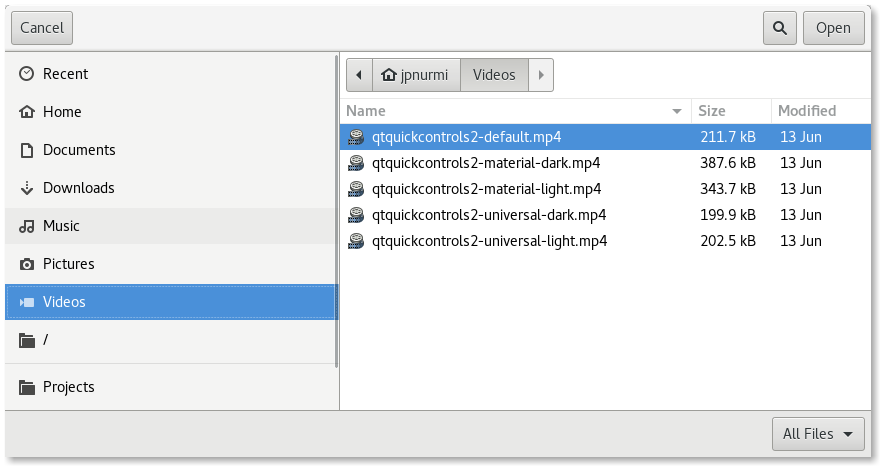
創建 QFileDialog 的最輕鬆方式是使用靜態函數,譬如 getOpenFileName ().
fileName = QFileDialog::getOpenFileName(this,
    tr("Open Image"), "/home/jana", tr("Image Files (*.png *.jpg *.bmp)"));
在以上範例中,使用靜態函數創建模態 QFileDialog。對話框初始顯示 /home/jana 目錄的內容,並顯示與字符串 Image files (*.png *.jpg *.bmp) 中給定模式匹配的文件。文件對話框父級被設為 this ,且窗口標題被設為 Open Image。
若想要使用多個過濾器,分隔每過濾器采用 two 分號。例如:
"Images (*.png *.xpm *.jpg);;Text files (*.txt);;XML files (*.xml)"
可以創建自己的 QFileDialog 無需使用靜態函數。通過調用 setFileMode (),可以指定用戶必須在對話框中選擇什麼:
QFileDialog dialog(this);
dialog.setFileMode(QFileDialog::AnyFile);
在以上範例中,文件對話框的模式被設為 AnyFile ,意味著用戶可以選擇任何文件,甚至指定不存在的文件。此模式對於創建 Save As (另存為) 文件對話框很有用。使用 ExistingFile 若用戶必須選擇現有文件,或 Directory 若隻能選擇目錄。見 QFileDialog::FileMode 枚舉瞭解模式的完整列錶。
The fileMode 特性包含對話框的操作模式;這指示用戶期望選擇什麼類型的對象。使用 setNameFilter () 以設置對話框的文件過濾器。例如:
dialog.setNameFilter(tr("Images (*.png *.xpm *.jpg)"));
在以上範例中,把過濾器設為
"Images (*.png *.xpm *.jpg)"
。這意味著僅文件具有擴展名
png
,
xpm
,或
jpg
會展示在 QFileDialog 中。可以應用多個過濾器通過使用
setNameFilters
()。使用
selectNameFilter
() 以選擇給齣的某一過濾器作為文件對話框默認過濾器。
文件對話框有 2 種查看模式: List and Detail . List 將當前目錄內容呈現為文件和目錄名稱列錶。 Detail 顯示文件和目錄名稱列錶,但每個名稱旁邊還提供額外信息 (譬如:文件大小和修改日期)。設置模式采用 setViewMode ():
dialog.setViewMode(QFileDialog::Detail);
創建自己的文件對話框時,需要使用的最後一個重要函數是 selectedFiles ().
QStringList fileNames;
if (dialog.exec())
    fileNames = dialog.selectedFiles();
在以上範例中,創建並展示模態文件對話框。若用戶點擊 OK,選中文件被放入
fileName
.
可以設置對話框的工作目錄采用 setDirectory ()。可以選擇當前目錄中的每個文件使用 selectFile () 函數。
The 標準對話框 範例展示如何使用 QFileDialog 及其它內置 Qt 對話框。
By default, a platform-native file dialog is used if the platform has one. In that case, the widgets that would otherwise be used to construct the dialog are not instantiated, so related accessors such as layout () 和 itemDelegate () return null. Also, not all platforms show file dialogs with a title bar, so be aware that the caption text might not be visible to the user. You can set the DontUseNativeDialog option or set the AA_DontUseNativeDialogs application attribute to ensure that the widget-based implementation is used instead of the native dialog.
另請參閱 QDir , QFileInfo , QFile , QColorDialog , QFontDialog ,和 標準對話框範例 .
| 常量 | 值 |
|---|---|
QFileDialog::AcceptOpen
|
0
|
QFileDialog::AcceptSave
|
1
|
| 常量 | 值 |
|---|---|
QFileDialog::LookIn
|
0
|
QFileDialog::FileName
|
1
|
QFileDialog::FileType
|
2
|
QFileDialog::Accept
|
3
|
QFileDialog::Reject
|
4
|
This enum is used to indicate what the user may select in the file dialog; that is, what the dialog returns if the user clicks OK.
| 常量 | 值 | 描述 |
|---|---|---|
QFileDialog::AnyFile
|
0
|
文件的名稱,無論它是否存在。 |
QFileDialog::ExistingFile
|
1
|
單個現有文件的名稱。 |
QFileDialog::Directory
|
2
|
目錄的名稱。顯示文件和目錄兩者。然而,本機 Windows 文件對話框不支持在目錄選取器中顯示文件。 |
QFileDialog::ExistingFiles
|
3
|
零個或多個現有文件的名稱。 |
另請參閱 setFileMode ().
影響對話框行為的選項。
| 常量 | 值 | 描述 |
|---|---|---|
QFileDialog::ShowDirsOnly
|
0x00000001
|
隻展示目錄。默認情況下,展示文件和目錄兩者。
此選項纔有效在 Directory 文件模式。 |
QFileDialog::DontResolveSymlinks
|
0x00000002
|
不解析符號鏈接。默認情況下,解析符號鏈接。 |
QFileDialog::DontConfirmOverwrite
|
0x00000004
|
不要求確認,若選中現有文件。默認情況下,請求確認。
此選項纔有效,若 acceptMode is AcceptSave 。此外,它不可以用於 macOS 的本機文件對話框。 |
QFileDialog::DontUseNativeDialog
|
0x00000008
|
不使用平颱本機文件對話框,而是使用由 Qt 提供的基於 Widget 的對話框。
默認情況下,展示本機文件對話框,除非使用子類化的 QFileDialog 包含 Q_OBJECT 宏,全局 AA_DontUseNativeDialogs 應用程序特性有設置 (或平颱沒有要求類型的本機對話框)。 要使選項有效,必須設置它,在改變對話框的其它屬性 (或展示對話框) 之前。 |
QFileDialog::ReadOnly
|
0x00000010
|
隻讀模型指示。 |
QFileDialog::HideNameFilterDetails
|
0x00000020
|
指示是否隱藏文件名過濾器細節。 |
QFileDialog::DontUseCustomDirectoryIcons
|
0x00000040
|
始終使用默認目錄圖標。
某些平颱允許用戶設置不同圖標,但自定義圖標查找在網絡 (或可移動驅動器) 中可能導緻顯著性能問題。 設置這將啓用 DontUseCustomDirectoryIcons 選項在 iconProvider (). 該枚舉值在 Qt 5.2 添加。 |
Options 類型是 typedef 對於 QFlags <Option>。它存儲 Option 值的 OR (或) 組閤。
另請參閱 options and testOption .
此枚舉描述文件對話框的視圖模式;也就是說,顯示每個文件的什麼信息。
| 常量 | 值 | 描述 |
|---|---|---|
QFileDialog::Detail
|
0
|
Displays an icon, a name, and details for each item in the directory. |
QFileDialog::List
|
1
|
Displays only an icon and a name for each item in the directory. |
另請參閱 setViewMode ().
此特性保持對話框的接受方式。
動作模式定義對話框是用於打開文件還是保存文件。
默認情況下,此特性被設為 AcceptOpen .
訪問函數:
| QFileDialog::AcceptMode | acceptMode () const |
| void | setAcceptMode (QFileDialog::AcceptMode mode ) |
另請參閱 AcceptMode .
Suffix added to the filename if no other suffix was specified.
This property specifies a string that is added to the filename if it has no suffix yet. The suffix is typically used to indicate the file type (e.g. "txt" indicates a text file).
If the first character is a dot ('.'), it is removed.
訪問函數:
| QString | defaultSuffix () const |
| void | setDefaultSuffix (const QString & suffix ) |
此特性保持對話框的文件模式。
The file mode defines the number and type of items that the user is expected to select in the dialog.
默認情況下,此特性被設為 AnyFile .
This function sets the labels for the FileName and Accept DialogLabel s. It is possible to set custom text after the call to setFileMode().
訪問函數:
| QFileDialog::FileMode | fileMode () const |
| void | setFileMode (QFileDialog::FileMode mode ) |
另請參閱 FileMode .
This property holds the various options that affect the look and feel of the dialog.
默認情況下,所有選項是被禁用的。
選項 (尤其 DontUseNativeDialog 選項) 應該設置,在改變對話框屬性 (或展示對話框) 之前。
設置選項當對話框可見時,不保證會立即影響對話框 (從屬選項和平颱)。
設置選項在改變其它特性後,可能導緻這些值不起作用。
訪問函數:
| QFileDialog::Options | options () const |
| void | setOptions (QFileDialog::Options options ) |
另請參閱 setOption () 和 testOption ().
This property holds the URL schemes that the file dialog should allow navigating to.
Setting this property allows to restrict the type of URLs the user can select. It is a way for the application to declare the protocols it supports to fetch the file content. An empty list means that no restriction is applied (the default). Support for local files ("file" scheme) is implicit and always enabled; it is not necessary to include it in the restriction.
訪問函數:
| QStringList | supportedSchemes () const |
| void | setSupportedSchemes (const QStringList & schemes ) |
This property holds the way files and directories are displayed in the dialog.
默認情況下,
Detail
mode is used to display information about files and directories.
訪問函數:
| QFileDialog::ViewMode | viewMode () const |
| void | setViewMode (QFileDialog::ViewMode mode ) |
另請參閱 ViewMode .
構造文件對話框采用給定 parent 和小部件 flags .
[explicit]
QFileDialog::
QFileDialog
(
QWidget
*
parent
= nullptr, const
QString
&
caption
= QString(), const
QString
&
directory
= QString(), const
QString
&
filter
= QString())
構造文件對話框采用給定 parent and caption that initially displays the contents of the specified directory . The contents of the directory are filtered before being shown in the dialog, using a semicolon-separated list of filters specified by filter .
[virtual noexcept]
QFileDialog::
~QFileDialog
()
銷毀文件對話框。
[override virtual protected]
void
QFileDialog::
accept
()
重實現: QDialog::accept ().
[override virtual protected]
void
QFileDialog::
changeEvent
(
QEvent
*
e
)
重實現: QWidget::changeEvent (QEvent *event).
[signal]
void
QFileDialog::
currentChanged
(const
QString
&
path
)
When the current file changes for local operations, this signal is emitted with the new file name as the path 參數。
另請參閱 filesSelected ().
[signal]
void
QFileDialog::
currentUrlChanged
(const
QUrl
&
url
)
When the current file changes, this signal is emitted with the new file URL as the url 參數。
另請參閱 urlsSelected ().
返迴目前顯示在對話框中的目錄。
另請參閱 setDirectory ().
[signal]
void
QFileDialog::
directoryEntered
(const
QString
&
directory
)
This signal is emitted for local operations when the user enters a directory .
Returns the url of the directory currently being displayed in the dialog.
另請參閱 setDirectoryUrl ().
[signal]
void
QFileDialog::
directoryUrlEntered
(const
QUrl
&
directory
)
此信號被發射當用戶鍵入 directory .
[override virtual protected]
void
QFileDialog::
done
(
int
result
)
重實現: QDialog::done (int r).
[signal]
void
QFileDialog::
fileSelected
(const
QString
&
file
)
When the selection changes for local operations and the dialog is accepted, this signal is emitted with the (possibly empty) selected file .
另請參閱 currentChanged () 和 QDialog::Accepted .
[signal]
void
QFileDialog::
filesSelected
(const
QStringList
&
selected
)
When the selection changes for local operations and the dialog is accepted, this signal is emitted with the (possibly empty) list of selected 文件。
另請參閱 currentChanged () 和 QDialog::Accepted .
返迴所用過濾器,當顯示文件時。
另請參閱 setFilter ().
[signal]
void
QFileDialog::
filterSelected
(const
QString
&
filter
)
此信號被發射,當用戶選擇 filter .
[static]
QString
QFileDialog::
getExistingDirectory
(
QWidget
*
parent
= nullptr, const
QString
&
caption
= QString(), const
QString
&
dir
= QString(),
QFileDialog::Options
options
= ShowDirsOnly)
This is a convenience static function that returns an existing directory selected by the user.
QString dir = QFileDialog::getExistingDirectory(this, tr("Open Directory"),
                                                "/home",
                                                QFileDialog::ShowDirsOnly
                                                | QFileDialog::DontResolveSymlinks);
此函數創建模態文件對話框采用給定
parent
小部件。若
parent
不是
nullptr
, the dialog is shown centered over the parent widget.
The dialog's working directory is set to dir , and the caption is set to caption . Either of these can be an empty string in which case the current directory and a default caption are used respectively.
The options argument holds various options about how to run the dialog. See the QFileDialog::Option enum for more information on the flags you can pass. To ensure a native file dialog, ShowDirsOnly must be set.
On Windows and macOS, this static function uses the native file dialog and not a QFileDialog . However, the native Windows file dialog does not support displaying files in the directory chooser. You need to pass the DontUseNativeDialog option, or set the global AA_DontUseNativeDialogs application attribute to display files using a QFileDialog .
Note that the macOS native file dialog does not show a title bar.
On Unix/X11, the normal behavior of the file dialog is to resolve and follow symlinks. For example, if
/usr/tmp
is a symlink to
/var/tmp
, the file dialog changes to
/var/tmp
after entering
/usr/tmp
。若
options
包括
DontResolveSymlinks
, the file dialog treats symlinks as regular directories.
On Windows, the dialog spins a blocking modal event loop that does not dispatch any QTimers, and if
parent
不是
nullptr
then it positions the dialog just below the parent's title bar.
另請參閱 getOpenFileName (), getOpenFileNames (),和 getSaveFileName ().
[static]
QUrl
QFileDialog::
getExistingDirectoryUrl
(
QWidget
*
parent
= nullptr, const
QString
&
caption
= QString(), const
QUrl
&
dir
= QUrl(),
QFileDialog::Options
options
= ShowDirsOnly, const
QStringList
&
supportedSchemes
= QStringList())
This is a convenience static function that returns an existing directory selected by the user. If the user presses Cancel, it returns an empty url.
函數的用法類似於 QFileDialog::getExistingDirectory ()。尤其 parent , caption , dir and options are used in exactly the same way.
The main difference with QFileDialog::getExistingDirectory () comes from the ability offered to the user to select a remote directory. That's why the return type and the type of dir is QUrl .
The supportedSchemes argument allows to restrict the type of URLs the user is able to select. It is a way for the application to declare the protocols it supports to fetch the file content. An empty list means that no restriction is applied (the default). Support for local files ("file" scheme) is implicit and always enabled; it is not necessary to include it in the restriction.
When possible, this static function uses the native file dialog and not a QFileDialog . On platforms that don't support selecting remote files, Qt allows to select only local files.
另請參閱 getExistingDirectory (), getOpenFileUrl (), getOpenFileUrls (),和 getSaveFileUrl ().
[static]
void
QFileDialog::
getOpenFileContent
(const
QString
&
nameFilter
, const
std::function
<
void
(const
QString
&, const
QByteArray
&)> &
fileOpenCompleted
,
QWidget
*
parent
= nullptr)
This is a convenience static function that returns the content of a file selected by the user.
Use this function to access local files on Qt for WebAssembly, if the web sandbox restricts file access. Its implementation enables displaying a native file dialog in the browser, where the user selects a file based on the nameFilter 參數。
parent is ignored on Qt for WebAssembly. Pass parent on other platforms, to make the popup a child of another widget. If the platform doesn't support native file dialogs, the function falls back to QFileDialog .
The function is asynchronous and returns immediately. The fileOpenCompleted callback will be called when a file has been selected and its contents have been read into memory.
auto fileContentReady = [](const QString &fileName, const QByteArray &fileContent) {
    if (fileName.isEmpty()) {
        // No file was selected
    } else {
        // Use fileName and fileContent
    }
};
QFileDialog::getOpenFileContent("Images (*.png *.xpm *.jpg)",  fileContentReady);
[static]
QString
QFileDialog::
getOpenFileName
(
QWidget
*
parent
= nullptr, const
QString
&
caption
= QString(), const
QString
&
dir
= QString(), const
QString
&
filter
= QString(),
QString
*
selectedFilter
= nullptr,
QFileDialog::Options
options
= Options())
This is a convenience static function that returns an existing file selected by the user. If the user presses Cancel, it returns a null string.
QString fileName = QFileDialog::getOpenFileName(this, tr("Open File"),
                                                "/home",
                                                tr("Images (*.png *.xpm *.jpg)"));
The function creates a modal file dialog with the given
parent
小部件。若
parent
不是
nullptr
, the dialog is shown centered over the parent widget.
The file dialog's working directory is set to dir 。若 dir includes a file name, the file is selected. Only files that match the given filter are shown. The selected filter is set to selectedFilter 。參數 dir , selectedFilter ,和 filter may be empty strings. If you want multiple filters, separate them with ';;', for example:
"Images (*.png *.xpm *.jpg);;Text files (*.txt);;XML files (*.xml)"
The options argument holds various options about how to run the dialog. See the QFileDialog::Option 枚舉瞭解可以傳遞標誌的更多有關信息。
把對話框標題設為 caption 。若 caption is not specified, then a default caption will be used.
On Windows, and macOS, this static function uses the native file dialog and not a QFileDialog . Note that the macOS native file dialog does not show a title bar.
On Windows the dialog spins a blocking modal event loop that does not dispatch any QTimers, and if
parent
不是
nullptr
then it positions the dialog just below the parent's title bar.
On Unix/X11, the normal behavior of the file dialog is to resolve and follow symlinks. For example, if
/usr/tmp
is a symlink to
/var/tmp
, the file dialog changes to
/var/tmp
after entering
/usr/tmp
。若
options
包括
DontResolveSymlinks
, the file dialog treats symlinks as regular directories.
另請參閱 getOpenFileNames (), getSaveFileName (),和 getExistingDirectory ().
[static]
QStringList
QFileDialog::
getOpenFileNames
(
QWidget
*
parent
= nullptr, const
QString
&
caption
= QString(), const
QString
&
dir
= QString(), const
QString
&
filter
= QString(),
QString
*
selectedFilter
= nullptr,
QFileDialog::Options
options
= Options())
This is a convenience static function that returns one or more existing files selected by the user.
QStringList files = QFileDialog::getOpenFileNames(
                        this,
                        "Select one or more files to open",
                        "/home",
                        "Images (*.png *.xpm *.jpg)");
此函數創建模態文件對話框采用給定
parent
小部件。若
parent
不是
nullptr
, the dialog is shown centered over the parent widget.
The file dialog's working directory is set to dir 。若 dir includes a file name, the file is selected. The filter is set to filter so that only those files which match the filter are shown. The filter selected is set to selectedFilter 。參數 dir , selectedFilter and filter can be empty strings. If you need multiple filters, separate them with ';;', for instance:
"Images (*.png *.xpm *.jpg);;Text files (*.txt);;XML files (*.xml)"
把對話框標題設為 caption 。若 caption 未指定,則使用默認標題。
On Windows and macOS, this static function uses the native file dialog and not a QFileDialog . Note that the macOS native file dialog does not show a title bar.
On Windows the dialog spins a blocking modal event loop that does not dispatch any QTimers, and if
parent
不是
nullptr
then it positions the dialog just below the parent's title bar.
On Unix/X11, the normal behavior of the file dialog is to resolve and follow symlinks. For example, if
/usr/tmp
is a symlink to
/var/tmp
, the file dialog will change to
/var/tmp
after entering
/usr/tmp
。
options
自變量保持有關如何運行對話框的各種選項,見
QFileDialog::Option
枚舉瞭解可以傳遞標誌的更多有關信息。
另請參閱 getOpenFileName (), getSaveFileName (),和 getExistingDirectory ().
[static]
QUrl
QFileDialog::
getOpenFileUrl
(
QWidget
*
parent
= nullptr, const
QString
&
caption
= QString(), const
QUrl
&
dir
= QUrl(), const
QString
&
filter
= QString(),
QString
*
selectedFilter
= nullptr,
QFileDialog::Options
options
= Options(), const
QStringList
&
supportedSchemes
= QStringList())
This is a convenience static function that returns an existing file selected by the user. If the user presses Cancel, it returns an empty url.
函數的用法類似於 QFileDialog::getOpenFileName ()。尤其 parent , caption , dir , filter , selectedFilter and options are used in exactly the same way.
The main difference with QFileDialog::getOpenFileName () comes from the ability offered to the user to select a remote file. That's why the return type and the type of dir is QUrl .
The supportedSchemes argument allows to restrict the type of URLs the user is able to select. It is a way for the application to declare the protocols it will support to fetch the file content. An empty list means that no restriction is applied (the default). Support for local files ("file" scheme) is implicit and always enabled; it is not necessary to include it in the restriction.
When possible, this static function uses the native file dialog and not a QFileDialog . On platforms that don't support selecting remote files, Qt will allow to select only local files.
另請參閱 getOpenFileName (), getOpenFileUrls (), getSaveFileUrl (),和 getExistingDirectoryUrl ().
[static]
QList
<
QUrl
> QFileDialog::
getOpenFileUrls
(
QWidget
*
parent
= nullptr, const
QString
&
caption
= QString(), const
QUrl
&
dir
= QUrl(), const
QString
&
filter
= QString(),
QString
*
selectedFilter
= nullptr,
QFileDialog::Options
options
= Options(), const
QStringList
&
supportedSchemes
= QStringList())
This is a convenience static function that returns one or more existing files selected by the user. If the user presses Cancel, it returns an empty list.
函數的用法類似於 QFileDialog::getOpenFileNames ()。尤其 parent , caption , dir , filter , selectedFilter and options are used in exactly the same way.
The main difference with QFileDialog::getOpenFileNames () comes from the ability offered to the user to select remote files. That's why the return type and the type of dir are respectively QList < QUrl > 和 QUrl .
The supportedSchemes argument allows to restrict the type of URLs the user can select. It is a way for the application to declare the protocols it supports to fetch the file content. An empty list means that no restriction is applied (the default). Support for local files ("file" scheme) is implicit and always enabled; it is not necessary to include it in the restriction.
When possible, this static function uses the native file dialog and not a QFileDialog . On platforms that don't support selecting remote files, Qt will allow to select only local files.
另請參閱 getOpenFileNames (), getOpenFileUrl (), getSaveFileUrl (),和 getExistingDirectoryUrl ().
[static]
QString
QFileDialog::
getSaveFileName
(
QWidget
*
parent
= nullptr, const
QString
&
caption
= QString(), const
QString
&
dir
= QString(), const
QString
&
filter
= QString(),
QString
*
selectedFilter
= nullptr,
QFileDialog::Options
options
= Options())
This is a convenience static function that returns a file name selected by the user. The file does not have to exist.
它創建模態文件對話框采用給定
parent
小部件。若
parent
不是
nullptr
,對話框將展示在父級 Widget 中心。
QString fileName = QFileDialog::getSaveFileName(this, tr("Save File"),
                           "/home/jana/untitled.png",
                           tr("Images (*.png *.xpm *.jpg)"));
The file dialog's working directory is set to dir 。若 dir includes a file name, the file is selected. Only files that match the filter 纔被展示。選中過濾器被設為 selectedFilter 。參數 dir , selectedFilter ,和 filter 可以是空字符串。多個過濾器采用 ;; 分隔。例如:
"Images (*.png *.xpm *.jpg);;Text files (*.txt);;XML files (*.xml)"
The options 自變量保持有關如何運行對話框的各種選項,見 QFileDialog::Option 枚舉瞭解可以傳遞標誌的更多有關信息。
可以選取默認過濾器通過設置 selectedFilter 到期望值。
把對話框標題設為 caption 。若 caption 未指定,使用默認標題。
On Windows, and macOS, this static function uses the native file dialog and not a QFileDialog .
On Windows the dialog spins a blocking modal event loop that does not dispatch any QTimers, and if
parent
不是
nullptr
then it positions the dialog just below the parent's title bar. On macOS, with its native file dialog, the filter argument is ignored.
On Unix/X11, the normal behavior of the file dialog is to resolve and follow symlinks. For example, if
/usr/tmp
is a symlink to
/var/tmp
, the file dialog changes to
/var/tmp
after entering
/usr/tmp
。若
options
包括
DontResolveSymlinks
, the file dialog treats symlinks as regular directories.
另請參閱 getOpenFileName (), getOpenFileNames (),和 getExistingDirectory ().
[static]
QUrl
QFileDialog::
getSaveFileUrl
(
QWidget
*
parent
= nullptr, const
QString
&
caption
= QString(), const
QUrl
&
dir
= QUrl(), const
QString
&
filter
= QString(),
QString
*
selectedFilter
= nullptr,
QFileDialog::Options
options
= Options(), const
QStringList
&
supportedSchemes
= QStringList())
這是返迴用戶選擇文件的方便靜態函數。文件不必存在。若用戶按下 Cancel,返迴空 URL。
函數的用法類似於 QFileDialog::getSaveFileName ()。尤其 parent , caption , dir , filter , selectedFilter and options are used in exactly the same way.
The main difference with QFileDialog::getSaveFileName () comes from the ability offered to the user to select a remote file. That's why the return type and the type of dir is QUrl .
The supportedSchemes argument allows to restrict the type of URLs the user can select. It is a way for the application to declare the protocols it supports to save the file content. An empty list means that no restriction is applied (the default). Support for local files ("file" scheme) is implicit and always enabled; it is not necessary to include it in the restriction.
When possible, this static function uses the native file dialog and not a QFileDialog . On platforms that don't support selecting remote files, Qt will allow to select only local files.
另請參閱 getSaveFileName (), getOpenFileUrl (), getOpenFileUrls (),和 getExistingDirectoryUrl ().
以路徑列錶形式返迴文件對話框的瀏覽曆史。
另請參閱 setHistory ().
返迴文件對話框使用的圖標提供程序。
另請參閱 setIconProvider ().
返迴用於在文件對話框視圖中呈現項的項委托。
另請參閱 setItemDelegate ().
返迴文件對話框展示的文本在指定 label .
另請參閱 setLabelText ().
返迴在此文件對話框中運轉的 MIME 類型過濾器。
另請參閱 setMimeTypeFilters ().
返迴在此文件對話框中運轉的文件類型過濾器。
另請參閱 setNameFilters ().
This function shows the dialog, and connects the slot specified by receiver and member to the signal that informs about selection changes. If the fileMode is ExistingFiles , this is the filesSelected () signal, otherwise it is the fileSelected () 信號。
從槽斷開信號連接,當關閉對話框時。
Returns the proxy model used by the file dialog. By default no proxy is set.
另請參閱 setProxyModel ().
Restores the dialogs's layout, history and current directory to the state 指定。
通常,這用於結閤 QSettings to restore the size from a past session.
返迴
false
若有錯誤
[static]
void
QFileDialog::
saveFileContent
(const
QByteArray
&
fileContent
, const
QString
&
fileNameHint
,
QWidget
*
parent
= nullptr)
This is a convenience static function that saves fileContent to a file, using a file name and location chosen by the user. fileNameHint can be provided to suggest a file name to the user.
Use this function to save content to local files on Qt for WebAssembly, if the web sandbox restricts file access. Its implementation enables displaying a native file dialog in the browser, where the user specifies an output file based on the fileNameHint 自變量。
parent is ignored on Qt for WebAssembly. Pass parent on other platforms, to make the popup a child of another widget. If the platform doesn't support native file dialogs, the function falls back to QFileDialog .
The function is asynchronous and returns immediately.
QByteArray imageData; // obtained from e.g. QImage::save()
QFileDialog::saveFileContent(imageData, "myimage.png"); // with filename hint
// OR
QFileDialog::saveFileContent(imageData); // no filename hint
Saves the state of the dialog's layout, history and current directory.
通常,這用於結閤 QSettings to remember the size for a future session. A version number is stored as part of the data.
選擇給定 filename 在文件對話框。
另請參閱 selectedFiles ().
設置當前 MIME 類型 filter .
設置當前文件類型 filter . Multiple filters can be passed in filter by separating them with semicolons or spaces.
另請參閱 setNameFilter (), setNameFilters (),和 selectedNameFilter ().
選擇給定 url 在文件對話框。
注意: 非本機 QFileDialog 僅支持本地文件。
另請參閱 selectedUrls ().
Returns a list of strings containing the absolute paths of the selected files in the dialog. If no files are selected, or the mode is not ExistingFiles or ExistingFile , selectedFiles() contains the current path in the viewport.
另請參閱 selectedNameFilter () 和 selectFile ().
Returns The mimetype of the file that the user selected in the file dialog.
Returns the filter that the user selected in the file dialog.
另請參閱 selectedFiles ().
Returns a list of urls containing the selected files in the dialog. If no files are selected, or the mode is not ExistingFiles or ExistingFile , selectedUrls() contains the current path in the viewport.
另請參閱 selectedNameFilter () 和 selectUrl ().
設置文件對話框的當前 directory .
注意:
在 iOS,若設置
directory
to
QStandardPaths::standardLocations(QStandardPaths::PicturesLocation).last
(), a native image picker dialog is used for accessing the user's photo album. The filename returned can be loaded using
QFile
and related APIs. For this to be enabled, the Info.plist assigned to QMAKE_INFO_PLIST in the project file must contain the key
NSPhotoLibraryUsageDescription
. See Info.plist documentation from Apple for more information regarding this key. This feature was added in Qt 5.5.
另請參閱 directory ().
這是重載函數。
設置文件對話框的當前 directory url.
注意: 非本機 QFileDialog 僅支持本地文件。
注意:
On Windows, it is possible to pass URLs representing one of the
virtual folders
, such as "Computer" or "Network". This is done by passing a
QUrl
使用方案
clsid
followed by the CLSID value with the curly braces removed. For example the URL
clsid:374DE290-123F-4565-9164-39C4925E467B
denotes the download location. For a complete list of possible values, see the MSDN documentation on
KNOWNFOLDERID
。該特徵在 Qt 5.5 添加。
另請參閱 directoryUrl () 和 QUuid .
將用於模型的過濾器設為 filters 。過濾器用於指定應展示的文件種類。
另請參閱 filter ().
設置文件對話框瀏覽曆史以包含給定 paths .
另請參閱 history ().
將用於文件對話框的圖標提供程序設為指定 provider .
另請參閱 iconProvider ().
Sets the item delegate used to render items in the views in the file dialog to the given delegate .
任何現有委托將被移除,但不被刪除。 QFileDialog 未擁有所有權對於 delegate .
警告: 不應該在視圖之間,共享實例化的相同委托。這樣做會導緻不正確 (或不直觀) 編輯行為,由於連接到給定委托的各視圖都可以接收 closeEditor () 信號,且試圖訪問、修改或關閉已關閉的編輯器。
Note that the model used is QFileSystemModel . It has custom item data roles, which is described by the Roles 枚舉。可以使用 QFileIconProvider 若隻想要自定義圖標。
另請參閱 itemDelegate (), setIconProvider (),和 QFileSystemModel .
設置 text 展示在文件對話框在指定 label .
另請參閱 labelText ().
設置 filters 以用於文件對話框,從 MIME 類型列錶。
Convenience method for setNameFilters ()。使用 QMimeType to create a name filter from the glob patterns and description defined in each MIME type.
Use application/octet-stream for the "All files (*)" filter, since that is the base MIME type for all files.
Calling setMimeTypeFilters overrides any previously set name filters, and changes the return value of nameFilters ().
QStringList mimeTypeFilters({"image/jpeg", // will show "JPEG image (*.jpeg *.jpg *.jpe)
                             "image/png",  // will show "PNG image (*.png)"
                             "application/octet-stream" // will show "All files (*)"
                            });
QFileDialog dialog(this);
dialog.setMimeTypeFilters(mimeTypeFilters);
dialog.exec();
另請參閱 mimeTypeFilters ().
將用於文件對話框的過濾器設為給定 filter .
若 filter contains a pair of parentheses containing one or more filename-wildcard patterns, separated by spaces, then only the text contained in the parentheses is used as the filter. This means that these calls are all equivalent:
dialog.setNameFilter("All C++ files (*.cpp *.cc *.C *.cxx *.c++)");
dialog.setNameFilter("*.cpp *.cc *.C *.cxx *.c++");
注意: With Android's native file dialog, the mime type matching the given name filter is used because only mime types are supported.
另請參閱 setMimeTypeFilters () 和 setNameFilters ().
設置 filters 用於文件對話框。
Note that the filter
*.*
is not portable, because the historical assumption that the file extension determines the file type is not consistent on every operating system. It is possible to have a file with no dot in its name (for example,
Makefile
). In a native Windows file dialog,
*.*
matches such files, while in other types of file dialogs it might not match. So, it's better to use
*
if you mean to select any file.
const QStringList filters({"Image files (*.png *.xpm *.jpg)",
                           "Text files (*.txt)",
                           "Any files (*)"
                          });
QFileDialog dialog(this);
dialog.setNameFilters(filters);
dialog.exec();
setMimeTypeFilters
() has the advantage of providing all possible name filters for each file type. For example, JPEG images have three possible extensions; if your application can open such files, selecting the
image/jpeg
mime type as a filter allows you to open all of them.
另請參閱 nameFilters ().
設置給定 option 為被啓用若 on 為 true;否則,清零給定 option .
選項 (尤其 DontUseNativeDialog 選項) 應該設置,在改變對話框屬性 (或展示對話框) 之前。
設置選項當對話框可見時,不保證會立即影響對話框 (從屬選項和平颱)。
設置選項在改變其它特性後,可能導緻這些值不起作用。
另請參閱 options and testOption ().
把視圖模型設為給定 proxyModel 。這很有用,若想要修改底層模型;例如:添加列、過濾數據、或添加驅動器。
移除任何現有代理模型,不刪除。文件對話框擁有所有權對於 proxyModel .
另請參閱 proxyModel ().
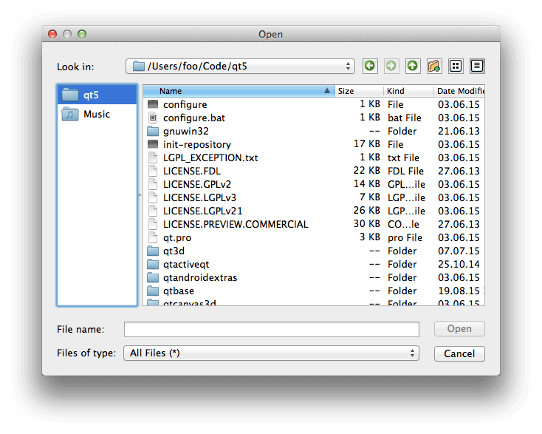
設置 urls 位於側邊欄中。
例如:
    QList<QUrl> urls;
    urls << QUrl::fromLocalFile("/Users/foo/Code/qt5")
         << QUrl::fromLocalFile(QStandardPaths::standardLocations(QStandardPaths::MusicLocation).first());
    QFileDialog dialog;
    dialog.setSidebarUrls(urls);
    dialog.setFileMode(QFileDialog::AnyFile);
    if (dialog.exec()) {
        // ...
    }
那麼,文件對話框看起來像這樣:
另請參閱 sidebarUrls ().
[override virtual]
void
QFileDialog::
setVisible
(
bool
visible
)
重實現: QDialog::setVisible (bool visible).
返迴目前在側邊欄中的 URL 列錶
另請參閱 setSidebarUrls ().
返迴
true
若給定
option
被啓用;否則,返迴 false。
另請參閱 options and setOption ().
[signal]
void
QFileDialog::
urlSelected
(const
QUrl
&
url
)
當選定改變且對話框接受時,此信號發射帶有 (可能空) 選中 url .
另請參閱 currentUrlChanged () 和 QDialog::Accepted .
[signal]
void
QFileDialog::
urlsSelected
(const
QList
<
QUrl
> &
urls
)
當選定改變且對話框接受時,此信號發射帶有 (可能空) 列錶選中 urls .
另請參閱 currentUrlChanged () 和 QDialog::Accepted .
