Used to select table cells inside a TableView . 更多...
| import 语句: |
import QtQuick.Controls
|
| Since: | Qt 6.2 |
| 继承: |
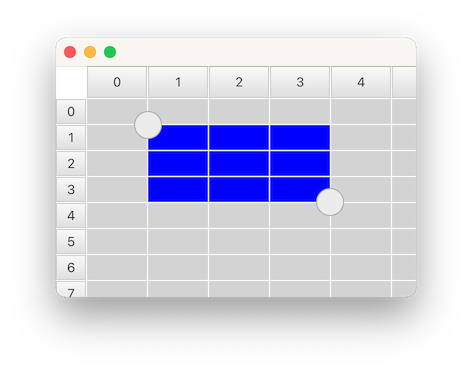
SelectionRectangle is used for selecting table cells in a TableView . It lets the user start a selection by doing a pointer drag inside the viewport, or by doing a long press on top of a cell.
For a SelectionRectangle to be able to select cells, TableView must have an ItemSelectionModel assigned. The ItemSelectionModel will store any selections done on the model, and can be used for querying which cells that the user has selected.
The following example shows how you can make a SelectionRectangle target a TableView :
    TableView {
        id: tableView
        anchors.fill: parent
        clip: true
        acceptedButtons: Qt.NoButton // mouse-drag changes selection
        model: TableModel {
            TableModelColumn { display: "name" }
            TableModelColumn { display: "age" }
            rows: [ { "name": "Harry", "age": "11" },
                    { "name": "Hedwig", "age": "8" } ]
        }
        selectionModel: ItemSelectionModel {
            model: tableView.model
        }
        delegate: TableViewDelegate { padding: 2 }
    }
    SelectionRectangle {
        target: tableView
    }
注意: A SelectionRectangle itself is not shown as part of a selection. Only the delegates (like topLeftHandle and bottomRightHandle ) are used. You should also consider rendering the TableView delegate as selected .
另请参阅 TableView , TableView::selectionModel ,和 ItemSelectionModel .
|
active
:
bool
|
此特性是
true
while the user is performing a selection. The selection will be active from the time the the user starts to select, and until the selection is removed again, for example from tapping inside the viewport.
|
bottomRightHandle : Component |
This property holds the delegate that will be shown on the center of the top-left corner of the selection rectangle. When a handle is provided, the user can drag it to adjust the selection.
The handle is not hidden by default when a selection is removed. Instead, this is the responsibility of the delegate, to open up for custom fade-out animations. The easiest way to ensure that the handle ends up hidden, is to simply bind visible 到 active state of the SelectionRectangle :
SelectionRectangle {
    bottomRightHandle: Rectangle {
        width: 20
        height: 20
        visible: SelectionRectangle.control.active
    }
}
把此特性设为
null
if you don't want a selection handle on the bottom-right.
另请参阅 topLeftHandle .
|
dragging
:
bool
|
此特性是
true
whenever the user is doing a pointer drag or a handle drag to adjust the selection rectangle.
|
selectionMode : enumeration |
This property holds when a selection should start.
| 常量 | 描述 |
|---|---|
SelectionRectangle.Drag
|
A selection will start by doing a pointer drag inside the viewport |
SelectionRectangle.PressAndHold
|
A selection will start by doing a press and hold on top of a cell |
SelectionRectangle.Auto
|
SelectionRectangle
will choose which mode to use based on the
target
and the input device in use. This normally means
Drag
when using a mouse, and
PressAndHold
on a touchscreen. However,
Drag
will only be used if it doesn't conflict with flicking. One way to avoid conflict is to disable mouse-drag flicking by setting
acceptedButtons
to
Qt.NoButton
. In that case, the mouse wheel or touchpad scrolling gesture continues to work, touchscreen flicking continues to work, and touchscreen selection can be started by press-and-hold. Another way is to set
interactive
to
false
, which disables flicking and scrolling altogether (perhaps this should be done only temporarily, in some mode in your UI). Yet another way is to place the
TableView
在
ScrollView
(where flicking, by default, is off for mouse events).
|
默认值为
Auto
.
|
target : Item |
此特性保持 TableView on which the SelectionRectangle should act.
|
topLeftHandle : Component |
This property holds the delegate that will be shown on the center of the top-left corner of the selection rectangle. When a handle is provided, the user can drag it to adjust the selection.
The handle is not hidden by default when a selection is removed. Instead, this is the responsibility of the delegate, to open up for custom fade-out animations. The easiest way to ensure that the handle ends up hidden, is to simply bind visible 到 active state of the SelectionRectangle :
SelectionRectangle {
    topLeftHandle: Rectangle {
        width: 20
        height: 20
        visible: SelectionRectangle.control.active
    }
}
把此特性设为
null
if you don't want a selection handle on the top-left.
另请参阅 bottomRightHandle .
|
SelectionRectangle.control : SelectionRectangle |
This attached property holds the SelectionRectangle that manages the delegate instance. It is attached to each handle instance.
|
SelectionRectangle.dragging : bool |
This attached property will be
true
if the user is dragging on the handle. It is attached to each handle instance.
