Creating a HTTP2 connection between a Qt gRPC ™ client and a C++ gRPC 服务器。
Magic 8 ball sends a question to a server and displays the received answer:
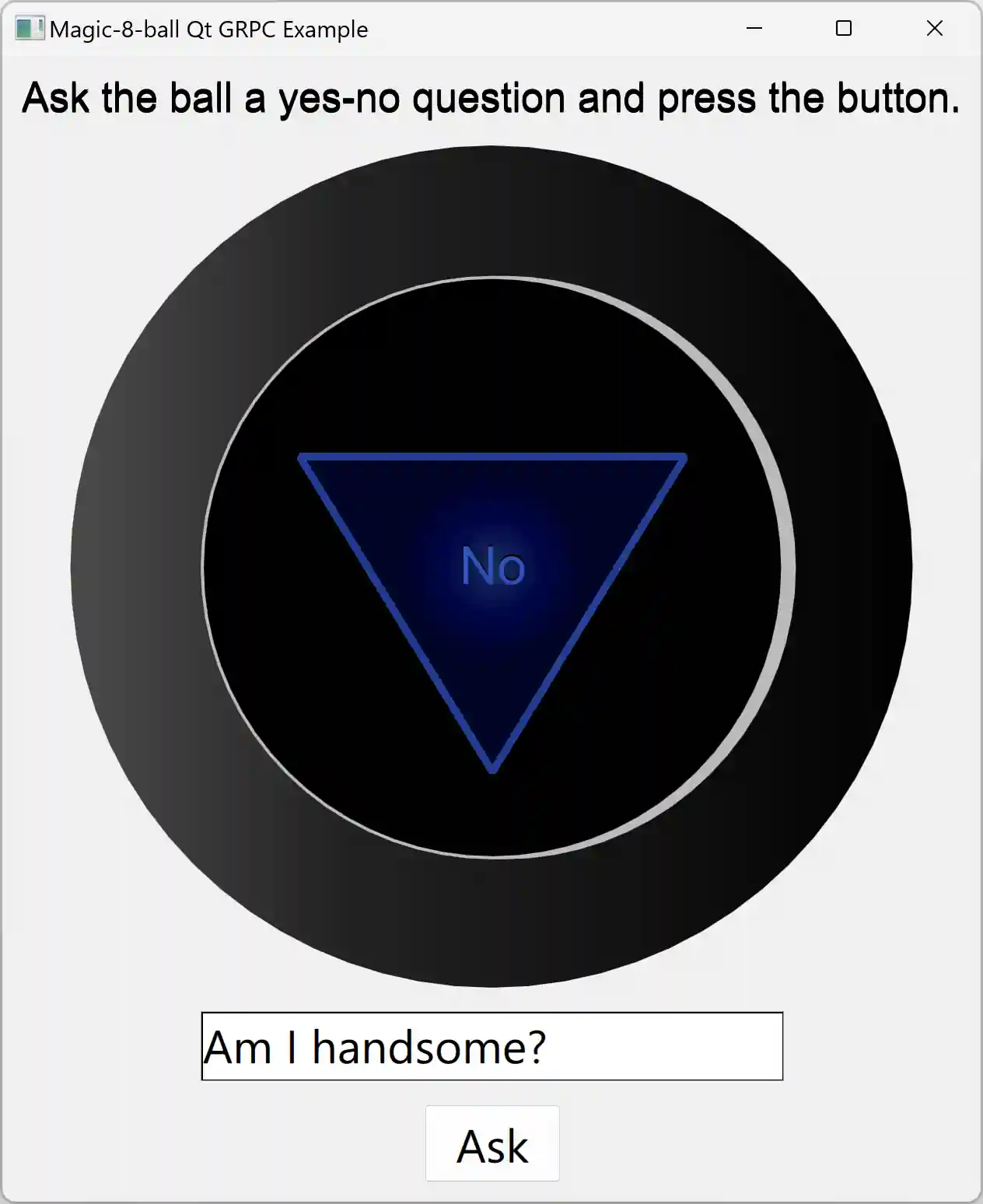
The example code includes the following components:
magic8ball
Qt
gRPC
client application that uses the
qt_add_protobuf()
and
qt_add_grpc()
CMake functions for message and service Qt code generation.
server
application that calls C++
gRPC
plugin for generating server code and implementing simple server logic.
注意: you need the C++ gRPC plugin installed. Find details here: 模块先决条件
Both components use generated messages from the protobuf schema described in the
exampleservice.proto
文件:
syntax = "proto3";
package qtgrpc.examples;
message AnswerRequest {
    string question = 1;
}
message AnswerResponse {
    string message = 1;
}
service ExampleService {
    rpc answerMethod(AnswerRequest) returns (AnswerResponse) {}
}
The gRPC client is defined as a QML object which is available after the code is compiled .
    ExampleServiceClient {
        id: grpcClient
        channel: grpcChannel.channel
    }
The client service connects to the
localhost
with port
50051
, which is specified in the
gRPC
channel options:
    GrpcHttp2Channel {
        id: grpcChannel
        hostUri: "http://localhost:50051"
        // Optionally, you can specify custom channel options here
        // options: GrpcChannelOptions {}
    }
And sends a request to the server part:
    function requestAnswer(question: string): void {
        ...
        root.answerReq.question = question;
        grpcClient.answerMethod(root.answerReq, finishCallback, errorCallback, grpcCallOptions);
    }
answerMethod
是
gRPC
method that the client calls. It has four parameters: the request object, a finish callback function, an error callback function and a
GrpcCallOptions
对象。
点击 Ask button to send the request to the magic8ball server.
注意: You have to run the server in parallel with the client application.
The
server
application chooses a random answer from the list of answers and sends the data to the client's port. It also checks that the request contains a non empty field
question
. If the field is empty, it returns a
StatusCode::INVALID_ARGUMENT
    grpc::Status answerMethod(grpc::ServerContext *, const AnswerRequest *request,
                              AnswerResponse *response) override
    {
        if (request->question().empty()) {
            std::cerr << "Question is empty" << std::endl;
            return grpc::Status(grpc::StatusCode::INVALID_ARGUMENT, "Question is empty");
        }
        std::cout << "Received question: " << request->question() << std::endl;
        response->set_message(getRandomAnswer());
        return grpc::Status();
    };
After receiving a response, the client application shows the answer.
